

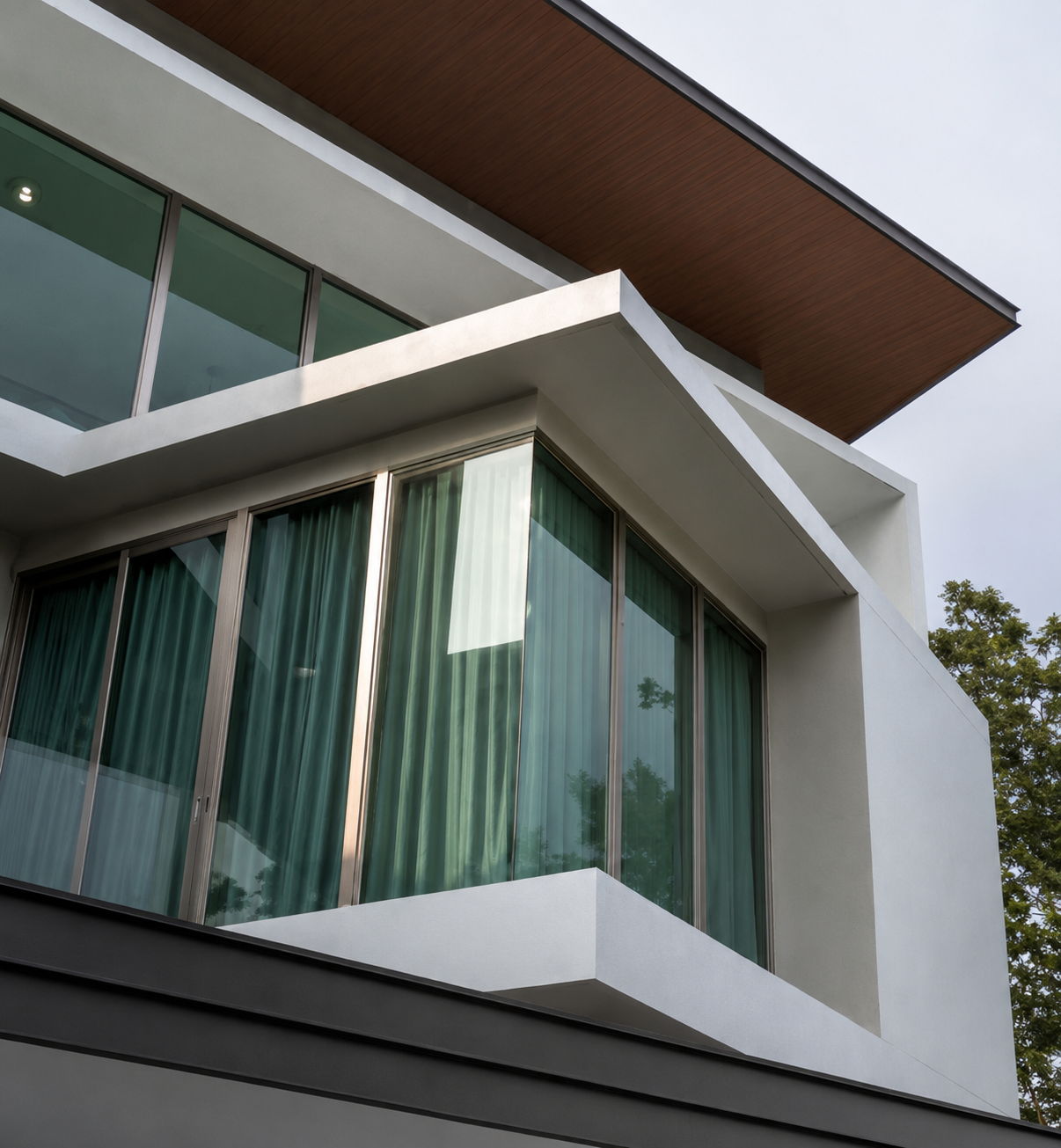
Big Glass Windows: How Large Can an Aluminium Window Go?
A bigger window isn't just a wider hole in the wall — past a certain size, it becomes a structural problem. Here's what actually makes big glass windows possible.
"Big glass windows" is what most homeowners ask for when they want a room to feel like it opens onto the view rather than just facing it. But a bigger window isn't a simple scale-up of a standard one — past a certain size, more glass means more wind load pushing on the frame, more weight for the frame to carry, and more risk of the whole unit flexing if it isn't engineered for the span.
Aluminium is what makes big glass windows practical in the first place. Its strength-to-weight ratio keeps a frame slim even as the glass panel grows, which is why large-format aluminium windows, glass-to-glass corner windows, and wide fixed-glass installations are almost always aluminium rather than timber or uPVC — those materials need noticeably thicker frames to carry the same span, which defeats the point of going big at all.
What actually limits how large a window can go isn't the glass alone — it's wind load, glass thickness and weight, and how much the frame is allowed to deflect under pressure before the seal fails. That's why our big-glass installations are engineered and tested to ASTM and AAMA wind-load standards rather than simply scaled up from a smaller, standard-size unit.
In a high-rise city like Mumbai, this matters even more. Upper-floor apartments see meaningfully higher wind pressure than street level, so a big glass window that performs perfectly on the third floor can behave very differently on the twenty-third. Any aluminium windows in Mumbai spec'd for large openings should be tested for the wind-load conditions of the actual floor they're going into, not a generic rating.
Fixed windows give the most uninterrupted glass for a view-facing wall, since there's no sash or track to interrupt the pane. Glass-to-glass corner windows take it further, removing the vertical frame member at a corner entirely so two panels meet with no visible break in the view. Either way, the frame should be the last thing anyone notices — which is exactly why it deserves proper engineering rather than an on-site improvisation.
Common questions, answered.
How big can an aluminium glass window actually go?
It depends on wind load, glass thickness, and frame support rather than a fixed number — a properly engineered aluminium system can support significantly larger openings than uPVC or timber, but every large-format installation should be sized and tested for its specific site, not just ordered off a catalogue size.
Are big glass windows more expensive than standard aluminium windows?
Generally yes — thicker glass, reinforced hardware, and wind-load testing add cost, which is part of why large-format glazing tends to sit at the premium end of aluminium windows rather than the entry level.
Which aluminium window systems handle big glass panels best in Mumbai?
Fixed windows and glass-to-glass corner windows carry the most glass with the least visible frame, and for Mumbai specifically, they should be part of a window system tested for high-rise wind load rather than a standard low-rise rating.
Do big glass windows compromise security or insulation?
Not when engineered correctly — thicker glass, multi-point locking, and EPDM gasket sealing on a properly tested system perform the same as (and sometimes better than) a smaller window with lighter-duty hardware.